High-Score (Bugfree Users) Amazon L4 SDE1 Interview Experience: 3 Rounds That Test Real-World Engineering
Short summary: I interviewed for Amazon SDE1 (L4) via referral and went through three focused rounds. Each round felt practical and engineering-centered: a mixed design+coding round, a behavioral round focused on Amazon Leadership Principles, and a pure coding round with data-structure tradeoffs.
The three rounds — what I faced and how to think about them
Round 1 — Mixed behavioral + coding (system-design + implementation)
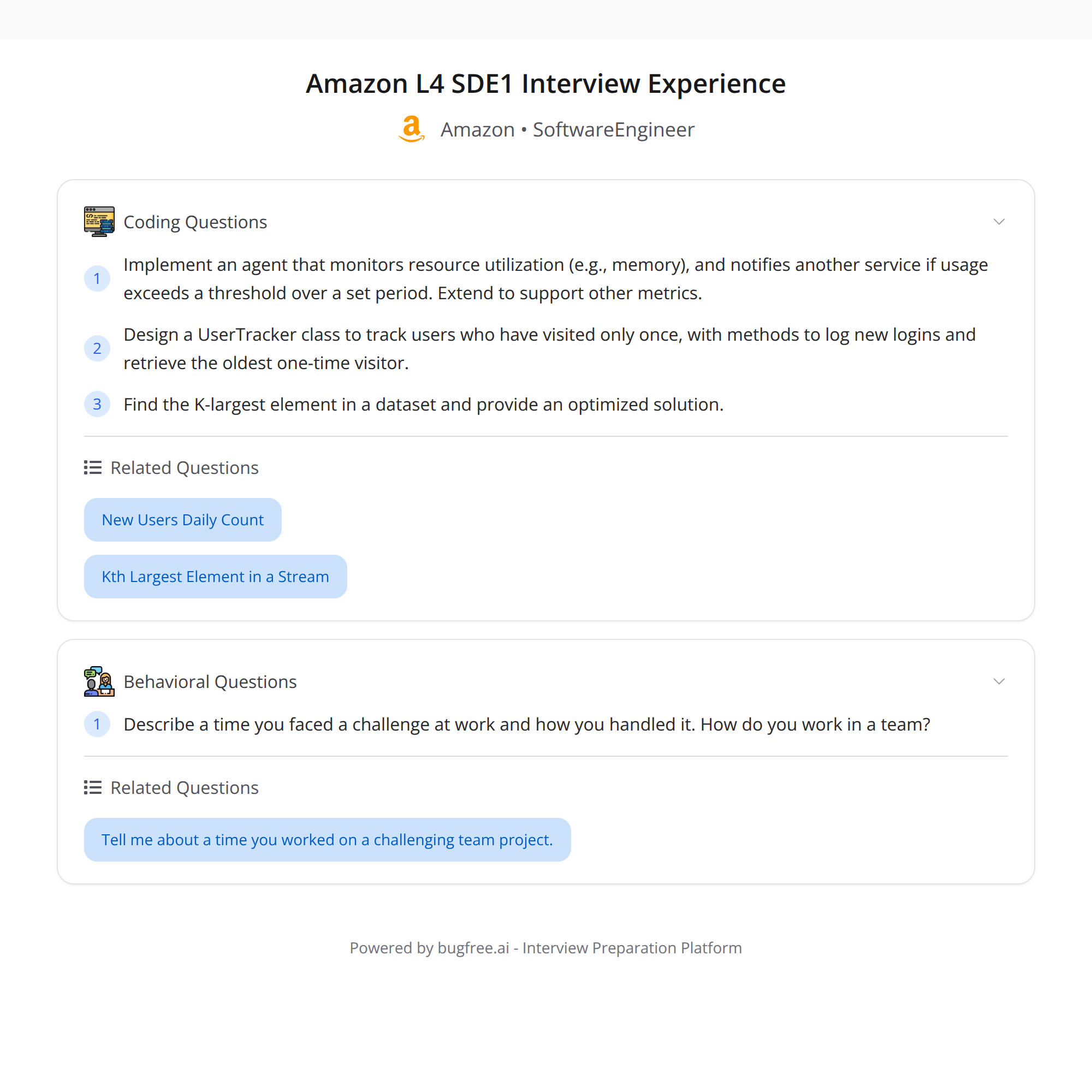
Problem example: design an extensible monitoring agent that can raise alerts such as "memory > 90% for 2 minutes".
What they’re testing
- Ability to translate real-world requirements into a simple, scalable design.
- Trade-offs between extensibility, performance, and simplicity.
- Clear reasoning and incremental delivery (what to implement first).
Approach (recommended)
- Clarify requirements: single host vs fleet, push vs pull metrics, alert definition language, retention, scale expectations.
- High-level architecture: collector (pollers or agents) → local processor → rules/alert engine → sink (logs/metrics/notification).
- Components and extensibility:
- Metric collectors: pluggable collectors for CPU/memory/custom metrics.
- Rule engine: supports threshold rules, windowing (e.g., >90% for 2 minutes), aggregation functions.
- Storage/stream: short-term in-memory rolling buffers + optional persistent store.
- Implementation details to mention: efficient sliding-window checks, debouncing alerts, handling clock skew, backpressure, configuration propagation.
- Example pseudocode for windowed threshold check:
For each metric sample:
  append timestamped value to ring buffer
  compute aggregate over last T seconds (e.g., max or average)
  if aggregate > threshold for duration D:
    emit alert (with dedup key)
Edge cases and follow-ups to discuss
- How to avoid duplicate alerts during flapping
- How to scale from one host to thousands (agent vs centralized collector)
- How to test and roll out new rule formats
Why this is a strong round: it rewards pragmatic system thinking and clear trade-offs — show you can design a minimal, testable solution and extend it.
Round 2 — Behavioral (Leadership Principles & teamwork)
Focus: Amazon’s Leadership Principles. Expect STAR-style questions that probe ownership, impact, conflict resolution, and customer obsession.
Common prompts and how to prepare
- "Tell me about a time you owned a project end-to-end." — emphasize decisions, trade-offs, and measurable outcomes.
- "Describe a time you disagreed with your manager." — show respectful challenge, data-driven reasoning, and alignment to goals.
- "Give an example of when you simplified a process or automated work." — show impact and thought process.
Preparation tips
- Prepare 6–8 STAR stories mapped to core principles: Customer Obsession, Ownership, Dive Deep, Bias for Action, Earn Trust, Invent and Simplify.
- Keep stories concise: Situation, Task, Action (focus on your actions), Result (quantified if possible).
- Practice articulating trade-offs and what you learned.
Why this matters: Amazon places strong weight on leadership principles. Solid, specific stories win more than vague achievements.
Round 3 — Pure coding (data structures + algorithm trade-offs)
Problems mentioned: 1) design a UserTracker to return the oldest one-time visitor efficiently; 2) K-largest element optimization (heap vs sort vs selection).
Problem 1: Oldest one-time visitor
- Goal: support visitor events (visitorId arrives) and be able to return the oldest visitor who has visited exactly once.
Efficient solution (O(1) per operation amortized)
- Maintain:
- A doubly linked list of visitors who are currently "unique" in their order of first visit (head = oldest unique).
- A hashmap from visitorId -> node pointer (if currently in list) or a special marker if seen >1.
- A count map or state enum: unseen, unique, or repeated.
- On arrival:
- If unseen -> append node to tail, mark unique, store node in map.
- If unique -> remove node from list, mark repeated, remove node pointer.
- If repeated -> do nothing.
- Querying oldest one-time visitor: read head of linked list (null if none).
This mirrors an LRU-style linked-list + map pattern but for the "first unique" semantics. It’s O(1) for updates and queries.
Problem 2: K-largest element trade-offs
- Sorting: O(n log n) — simple and sometimes fastest for small n or when you need a fully sorted output.
- Min-heap of size K: O(n log k) — ideal when k << n and you only need K largest.
- Quickselect (Hoare’s selection): average O(n), worst-case O(n^2) — good when you need the K-th largest (or partition) quickly without extra memory.
When to choose what
- If n is large and k is small: use a min-heap of size k.
- If you need the exact sorted top-K: heap + final sort of K elements (k log k) or partial sort.
- If you need guaranteed linear-time worst-case: use introselect variants or median-of-medians (rare in interviews; mention it if they push worst-case guarantees).
Final tips and prep checklist
- Practice implementing linked list + hashmap patterns (recently seen in Round 3).
- Work on small system-design problems: focus on clarifying requirements, identifying components, and discussing trade-offs.
- Prepare 6–8 STAR stories mapped to Leadership Principles — practice concise delivery and measurable outcomes.
- For algorithm rounds, be ready to discuss time/space complexity and alternative approaches (heap vs sort vs selection).
Good luck — the rounds are pragmatic and reward engineers who can reason clearly, design simply, and implement efficiently. #SoftwareEngineering #InterviewPrep #DataStructures
About the author
bugfree.ai is an advanced AI-powered platform designed to help software engineers master system design and behavioral interviews. Whether you’re preparing for your first interview or aiming to elevate your skills, bugfree.ai provides a robust toolkit tailored to your needs. Key Features:
150+ system design questions: Master challenges across all difficulty levels and problem types, including 30+ object-oriented design and 20+ machine learning design problems. Targeted practice: Sharpen your skills with focused exercises tailored to real-world interview scenarios. In-depth feedback: Get instant, detailed evaluations to refine your approach and level up your solutions. Expert guidance: Dive deep into walkthroughs of all system design solutions like design Twitter, TinyURL, and task schedulers. Learning materials: Access comprehensive guides, cheat sheets, and tutorials to deepen your understanding of system design concepts, from beginner to advanced. AI-powered mock interview: Practice in a realistic interview setting with AI-driven feedback to identify your strengths and areas for improvement.
bugfree.ai goes beyond traditional interview prep tools by combining a vast question library, detailed feedback, and interactive AI simulations. It’s the perfect platform to build confidence, hone your skills, and stand out in today’s competitive job market. Suitable for:
New graduates looking to crack their first system design interview. Experienced engineers seeking advanced practice and fine-tuning of skills. Career changers transitioning into technical roles with a need for structured learning and preparation.
Comments
Join the discussionNo comments yet. Be the first to comment.