
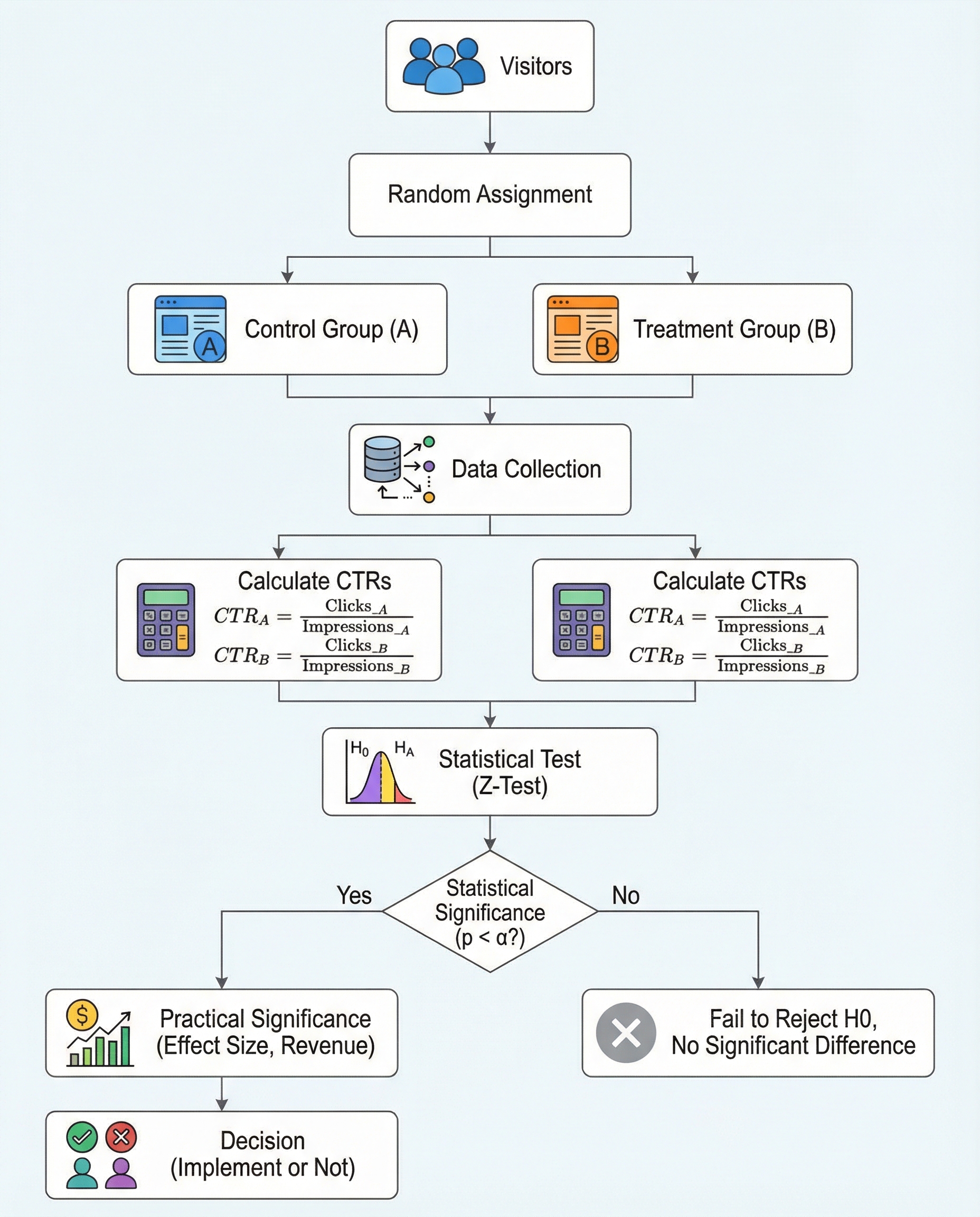
Most candidates miss a small but crucial point in two-proportion z-tests: when you test H0: CTR_A = CTR_B you must compute the standard error using the pooled rate.
Why? Because the null hypothesis says the two groups share the same underlying rate p. Under H0 you therefore estimate one shared p from all the data:
p_pooled = (clicks_A + clicks_B) / (impr_A + impr_B)
Then the standard error for the difference in sample proportions is
SE_pooled = sqrt( p_pooled (1 - p_pooled) (1/n_A + 1/n_B) )
If you don't pool (i.e., if you use the separate-sample SE), you can inflate or deflate the SE and flip your "significant" decision. The pooled SE is what the theory for the two-proportion z-test requires because the test assumes a common p under H0.
Quick numeric demonstration
- A: n_A = 10,000 impressions, x_A = 200 clicks -> p_A = 0.0200
- B: n_B = 1,000 impressions, x_B = 30 clicks -> p_B = 0.0300
- Difference in sample proportions = p_B - p_A = 0.01
Pooled estimate:
- p_pooled = 230 / 11,000 ≈ 0.020909
- SE_pooled = sqrt(0.020909 0.979091 (1/10000 + 1/1000)) ≈ 0.00475
- z = 0.01 / 0.00475 ≈ 2.106 → two-sided p ≈ 0.035 (statistically significant at α = 0.05)
Unpooled (separate) SE:
- SE_unpooled = sqrt( p_A(1-p_A)/n_A + p_B(1-p_B)/n_B ) ≈ 0.00557
- z = 0.01 / 0.00557 ≈ 1.794 → two-sided p ≈ 0.072 (not significant at α = 0.05)
Same data, two different decisions—because one calculation pooled the rates (appropriate for hypothesis testing under H0) and the other didn't.
Interview-friendly rule of thumb
- For hypothesis testing of equality of two proportions (two-proportion z-test): use the pooled standard error.
- For estimating effect size or constructing confidence intervals for each proportion or for the difference: use the unpooled (separate) standard error.
Quick caveats and tips
- The two-proportion z-test (pooled SE) relies on large-sample approximations. For small counts (especially <5 expected events in a cell), use Fisher's exact test or exact/adjusted methods.
- If you want to be conservative when samples are small or assumptions shaky, consider exact tests or permutation/bootstrap approaches.
- In interviews: state the null hypothesis, show how you compute p_pooled, write the pooled SE formula, and say when you’d switch to an exact test. That demonstrates both theory and practical judgment.
Bottom line: pooled SE for hypothesis testing (equality under H0); unpooled SE for confidence intervals and estimation. Mixing them up is a common interview pitfall—now you won't make that mistake.
About the author
bugfree.ai is an advanced AI-powered platform designed to help software engineers master system design and behavioral interviews. Whether you’re preparing for your first interview or aiming to elevate your skills, bugfree.ai provides a robust toolkit tailored to your needs. Key Features:
150+ system design questions: Master challenges across all difficulty levels and problem types, including 30+ object-oriented design and 20+ machine learning design problems. Targeted practice: Sharpen your skills with focused exercises tailored to real-world interview scenarios. In-depth feedback: Get instant, detailed evaluations to refine your approach and level up your solutions. Expert guidance: Dive deep into walkthroughs of all system design solutions like design Twitter, TinyURL, and task schedulers. Learning materials: Access comprehensive guides, cheat sheets, and tutorials to deepen your understanding of system design concepts, from beginner to advanced. AI-powered mock interview: Practice in a realistic interview setting with AI-driven feedback to identify your strengths and areas for improvement.
bugfree.ai goes beyond traditional interview prep tools by combining a vast question library, detailed feedback, and interactive AI simulations. It’s the perfect platform to build confidence, hone your skills, and stand out in today’s competitive job market. Suitable for:
New graduates looking to crack their first system design interview. Experienced engineers seeking advanced practice and fine-tuning of skills. Career changers transitioning into technical roles with a need for structured learning and preparation.
Comments
Join the discussionNo comments yet. Be the first to comment.


