# High-Score (Bugfree Users) Interview Experience: Walmart Senior Software Engineer — Why the Hiring Manager Round Can Make or Break It
High-Score Interview Experience (Bugfree Users): Walmart Senior Software Engineer — Why the Hiring Manager Round Can Make or Break It
### Quick summary
I cleared the DSA, low-level design (LLD), and system design rounds for Walmart’s Senior Software Engineer role. The hiring manager (HM) round, however, covered a surprising mix: coding, parallelism, architecture trade-offs, and behavioral questions. The HM round can strongly influence the final outcome — here’s what was asked, why it matters, and how to prepare.
---
## What happened before the HM round
- DSA: Problem-solving and algorithmic correctness.
- LLD: Design of components, interfaces, and class behaviors.
- System Design: High-level architecture, scalability, and trade-offs.
Clearing these shows you can code and design. The HM round then verifies depth, practical trade-offs, and fit.
## The Hiring Manager round — topics and sample directions
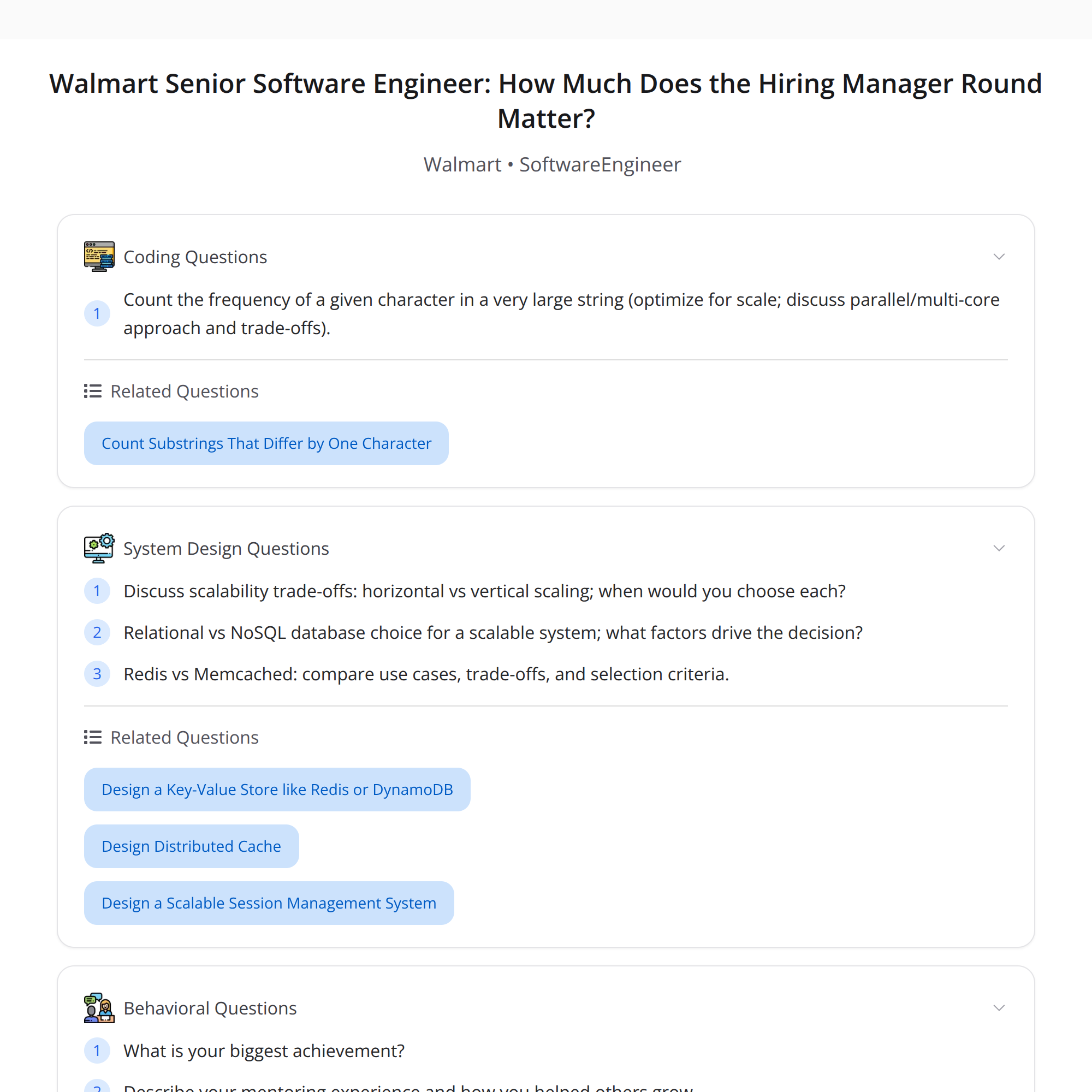
1. Coding (surprising but important)
- Problem: compute character frequencies in a *very large* string.
- Expectation: discuss memory constraints, streaming solutions, and parallel approaches rather than just a naive hashmap.
- Practical angles to cover: chunked streaming, external sorting, or using a distributed map-reduce style aggregation.
2. Parallelism / Multi-core trade-offs
- Discussion points: how to partition input, synchronization overhead, cache contention, Amdahl’s Law, and when multi-threading actually helps.
- Things to mention: workload granularity, lock-free designs or sharding to reduce contention, and overhead vs throughput trade-offs.
3. Real-world architecture questions
- Horizontal vs vertical scaling: when to scale out (more machines) vs scale up (bigger machines); cost, failure domains, and operational complexity.
- Relational vs NoSQL: consistency needs, query patterns, transaction requirements, and schema flexibility.
- Caching decisions: Redis vs Memcached — Redis for rich structures and persistence features; Memcached for simple, volatile object caching at scale.
4. Behavioral / ownership
- Common HM prompts: your biggest achievement, examples of mentoring and influencing peers, and situations where you owned a release or a critical incident.
- Focus: clear impact, measurable outcomes, collaboration, and what you learned.
---
## Why the HM round matters
- Hiring managers synthesize technical ability, product judgment, and team fit. They often make the final hiring call.
- They probe for depth: can you move from algorithm/design to production trade-offs and people/ownership aspects?
- A strong HM conversation can override minor technical gaps earlier — conversely, a weak HM impression can sink an otherwise perfect technical loop.
## Concrete prep checklist
- Revisit streaming and memory-efficient algorithms for large inputs (external algorithms, chunking, streaming aggregations).
- Be ready to reason about parallelism: partitioning, synchronization, overhead, and when it’s not worth parallelizing.
- Prepare concise explanations about scaling choices, database trade-offs, and caching strategies with examples from real systems.
- Have 2–3 behavioral stories following the CAR (Context, Action, Result) or STAR format focusing on impact, mentoring, and release ownership.
- Practice explaining trade-offs aloud — HMs care about your thought process, not just the final answer.
## Final tip
Treat the HM round as both technical and strategic: show you can code, but also that you understand production trade-offs and can lead and influence. That combination often decides the final outcome.
---
Tags: #SoftwareEngineering #SystemDesign #InterviewPrep