# OOD Interviews: Master UML + Whiteboarding (or Get Stuck Explaining Ideas)
OOD Interviews: Master UML + Whiteboarding (or Get Stuck Explaining Ideas)
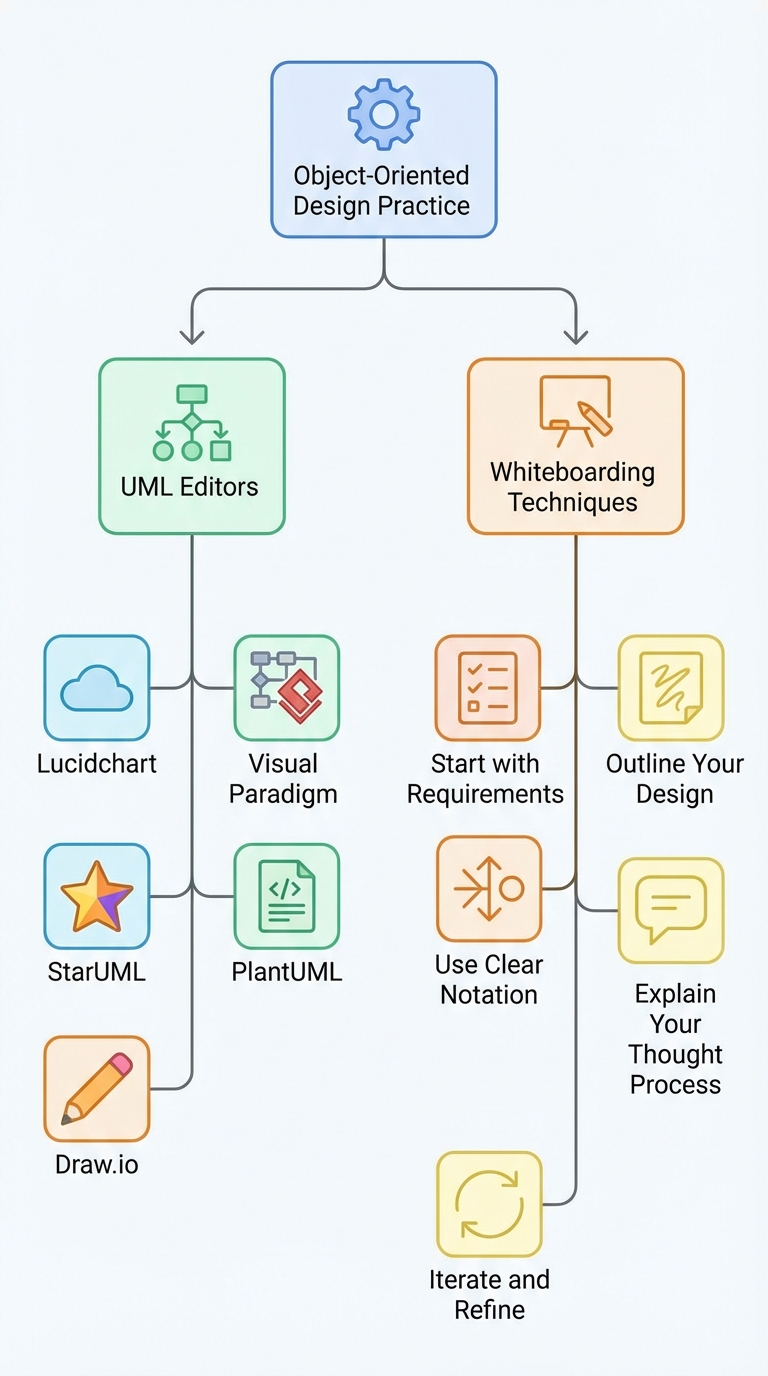 Object-oriented design (OOD) interviews evaluate two things at once: how you think about designs and how quickly you communicate them. You can have brilliant ideas, but if you can't present them clearly on a whiteboard (or equivalent), interviewers will struggle to follow and challenge you. Train both design thinking and rapid communication.
Why UML helps
- UML forces clarity. Turning ideas into classes, relationships, and interactions reveals gaps and assumptions.
- Modeling tools speed iteration and make notation consistent. Use a diagram editor to practice so you build muscle memory for symbols and layout.
Recommended tools
- Visual, drag-and-drop: Lucidchart, Draw.io (diagrams.net), Visual Paradigm, StarUML
- Text-first (great for version control): PlantUML, Mermaid
What interviewers expect (the whiteboard reality)
1. Start from requirements
- Restate and clarify constraints and assumptions aloud. Ask one or two clarifying questions—this shows you understand scope.
2. Sketch a high-level design
- Identify major components and responsibilities before dropping into class details.
3. Use consistent notation
- Simple UML class boxes, arrows for relationships, labels for multiplicity/ownership. If you deviate, say so.
4. Narrate your decisions
- Explain why a class exists, what its responsibilities are, and why you chose a relationship or pattern.
5. Iterate when challenged
- Accept feedback, show trade-offs, and adapt your design. This demonstrates flexibility and systems thinking.
Concrete checklist for class diagrams
- Name classes clearly and add a short responsibility note if space allows.
- Define key attributes and public methods—don’t attempt every method, focus on the interface.
- Show relationships: association, aggregation, composition, inheritance; annotate multiplicities when relevant.
- Identify important interactions with sequence diagrams for critical flows (e.g., user request ➜ controller ➜ service ➜ repository).
- Call out non-functional concerns: scalability, consistency, fault tolerance (brief bullet points beside the diagram).
Sequence diagrams and interactions
A class diagram shows structure; a sequence diagram shows behavior. For most interview problems, sketch one short sequence for the main happy path. That helps interviewers see how objects collaborate and where bottlenecks or failure modes might be.
PlantUML and version control
If you practice in text-to-UML (PlantUML, Mermaid), you get reproducible diagrams and easy diffs—great for tracking your learning and sharing examples in a portfolio.
Weekly practice plan (30–60 minutes)
- Week structure:
1. Pick one interview prompt (e.g., “design a parking lot”, “URL shortener”, “chat system”).
2. 5 min: clarify requirements aloud.
3. 10–15 min: sketch high-level components and class diagram.
4. 10 min: draw a sequence diagram for the main flow.
5. 5–10 min: explain trade-offs, scalability, and edge cases.
- Record yourself or practice with a partner to get feedback on clarity and pace.
Whiteboarding delivery tips
- Talk while you draw. Silence looks like thinking—explain what each box and arrow represents.
- Use consistent, legible handwriting and leave space for iteration.
- When you don’t know something, state an assumption rather than staying silent.
- Use names for objects (e.g., PaymentService) instead of vague labels (e.g., Thing).
Common pitfalls to avoid
- Diving into method signatures before explaining high-level responsibilities.
- Using inconsistent symbols without telling the interviewer what they mean.
- Failing to discuss trade-offs and constraints (time, memory, throughput).
Final note
Design clarity and communication are equally important in OOD interviews. Use UML tools to sharpen your mental models, practice whiteboarding weekly, and always narrate the rationale behind your choices. Over time your designs will be sharper, easier to defend, and much easier for interviewers to follow.
#ObjectOrientedDesign #OOD #UML #SystemDesign #SoftwareEngineering #InterviewPrep #Whiteboarding
Object-oriented design (OOD) interviews evaluate two things at once: how you think about designs and how quickly you communicate them. You can have brilliant ideas, but if you can't present them clearly on a whiteboard (or equivalent), interviewers will struggle to follow and challenge you. Train both design thinking and rapid communication.
Why UML helps
- UML forces clarity. Turning ideas into classes, relationships, and interactions reveals gaps and assumptions.
- Modeling tools speed iteration and make notation consistent. Use a diagram editor to practice so you build muscle memory for symbols and layout.
Recommended tools
- Visual, drag-and-drop: Lucidchart, Draw.io (diagrams.net), Visual Paradigm, StarUML
- Text-first (great for version control): PlantUML, Mermaid
What interviewers expect (the whiteboard reality)
1. Start from requirements
- Restate and clarify constraints and assumptions aloud. Ask one or two clarifying questions—this shows you understand scope.
2. Sketch a high-level design
- Identify major components and responsibilities before dropping into class details.
3. Use consistent notation
- Simple UML class boxes, arrows for relationships, labels for multiplicity/ownership. If you deviate, say so.
4. Narrate your decisions
- Explain why a class exists, what its responsibilities are, and why you chose a relationship or pattern.
5. Iterate when challenged
- Accept feedback, show trade-offs, and adapt your design. This demonstrates flexibility and systems thinking.
Concrete checklist for class diagrams
- Name classes clearly and add a short responsibility note if space allows.
- Define key attributes and public methods—don’t attempt every method, focus on the interface.
- Show relationships: association, aggregation, composition, inheritance; annotate multiplicities when relevant.
- Identify important interactions with sequence diagrams for critical flows (e.g., user request ➜ controller ➜ service ➜ repository).
- Call out non-functional concerns: scalability, consistency, fault tolerance (brief bullet points beside the diagram).
Sequence diagrams and interactions
A class diagram shows structure; a sequence diagram shows behavior. For most interview problems, sketch one short sequence for the main happy path. That helps interviewers see how objects collaborate and where bottlenecks or failure modes might be.
PlantUML and version control
If you practice in text-to-UML (PlantUML, Mermaid), you get reproducible diagrams and easy diffs—great for tracking your learning and sharing examples in a portfolio.
Weekly practice plan (30–60 minutes)
- Week structure:
1. Pick one interview prompt (e.g., “design a parking lot”, “URL shortener”, “chat system”).
2. 5 min: clarify requirements aloud.
3. 10–15 min: sketch high-level components and class diagram.
4. 10 min: draw a sequence diagram for the main flow.
5. 5–10 min: explain trade-offs, scalability, and edge cases.
- Record yourself or practice with a partner to get feedback on clarity and pace.
Whiteboarding delivery tips
- Talk while you draw. Silence looks like thinking—explain what each box and arrow represents.
- Use consistent, legible handwriting and leave space for iteration.
- When you don’t know something, state an assumption rather than staying silent.
- Use names for objects (e.g., PaymentService) instead of vague labels (e.g., Thing).
Common pitfalls to avoid
- Diving into method signatures before explaining high-level responsibilities.
- Using inconsistent symbols without telling the interviewer what they mean.
- Failing to discuss trade-offs and constraints (time, memory, throughput).
Final note
Design clarity and communication are equally important in OOD interviews. Use UML tools to sharpen your mental models, practice whiteboarding weekly, and always narrate the rationale behind your choices. Over time your designs will be sharper, easier to defend, and much easier for interviewers to follow.
#ObjectOrientedDesign #OOD #UML #SystemDesign #SoftwareEngineering #InterviewPrep #Whiteboarding