# Java OOD Interviews: Stop Memorizing—Start Designing
# Java OOD Interviews: Stop Memorizing—Start Designing
Memorizing code snippets won't get you far in Java object-oriented design (OOD) interviews. Interviewers are evaluating how you think about design: how you identify responsibilities, choose abstractions, and defend trade-offs. Focus on principles, apply Java's tools correctly, and communicate clearly.
## Think in Principles, Not Snippets
Start from the fundamentals. The four pillars of OOP should guide your decisions:
- Encapsulation — keep state private and expose behaviour through well-defined methods.
- Abstraction — hide implementation details behind interfaces or abstract classes.
- Inheritance — use only when there's a clear "is-a" relationship; prefer composition otherwise.
- Polymorphism — design systems that operate on abstractions, not concrete classes.
When you answer, explicitly mention which principles you’re using and why.
## Use Java Tools the Right Way
Know the practical differences and when to use them:
- Interfaces vs Abstract Classes
- Interface: use for capabilities and when multiple inheritance of type is needed (default/static methods are available in modern Java).
- Abstract class: use when you want to share common state or partial implementation.
- Trade-off: Interfaces maximize flexibility; abstract classes simplify shared behavior.
- Access Modifiers
- public, protected, package-private, private — pick the narrowest scope that still allows required access.
- Prefer composition and package-private helpers over public utility methods to reduce coupling.
- Collections & Concurrency
- Choose the right collection (List vs Set vs Map) based on uniqueness and ordering.
- Know thread-safe collections or synchronization strategies if the system is concurrent.
Always justify your choices (readability, testability, performance, extensibility).
## Core Patterns to Practice (and How to Explain Them)
- Singleton
- Use when one and only one instance must exist (e.g., configuration manager).
- Trade-offs: global state and testing complexity; consider dependency injection instead.
- Factory (Factory Method / Abstract Factory)
- Use to centralize object creation, hide concrete types, and support easy extension.
- Trade-offs: more indirection but better decoupling and testability.
- Observer
- Good for event-driven systems where many components need to react to changes.
- Trade-offs: potential memory leaks if listeners are not removed; harder to trace control flow.
When naming a pattern, also describe why it fits the problem and what you’d watch out for.
## System Design Approach — Step by Step
A repeatable interview workflow helps clarity:
1. Clarify requirements and constraints (functional + non-functional).
2. Identify primary entities and their responsibilities.
3. Define relationships and cardinality.
4. Sketch a high-level UML or class diagram.
5. Design public APIs (core methods) for main classes.
6. Discuss data storage, scaling, threading, and failure modes if relevant.
7. Explain trade-offs and possible alternatives.
Keep each step short and verbalize assumptions.
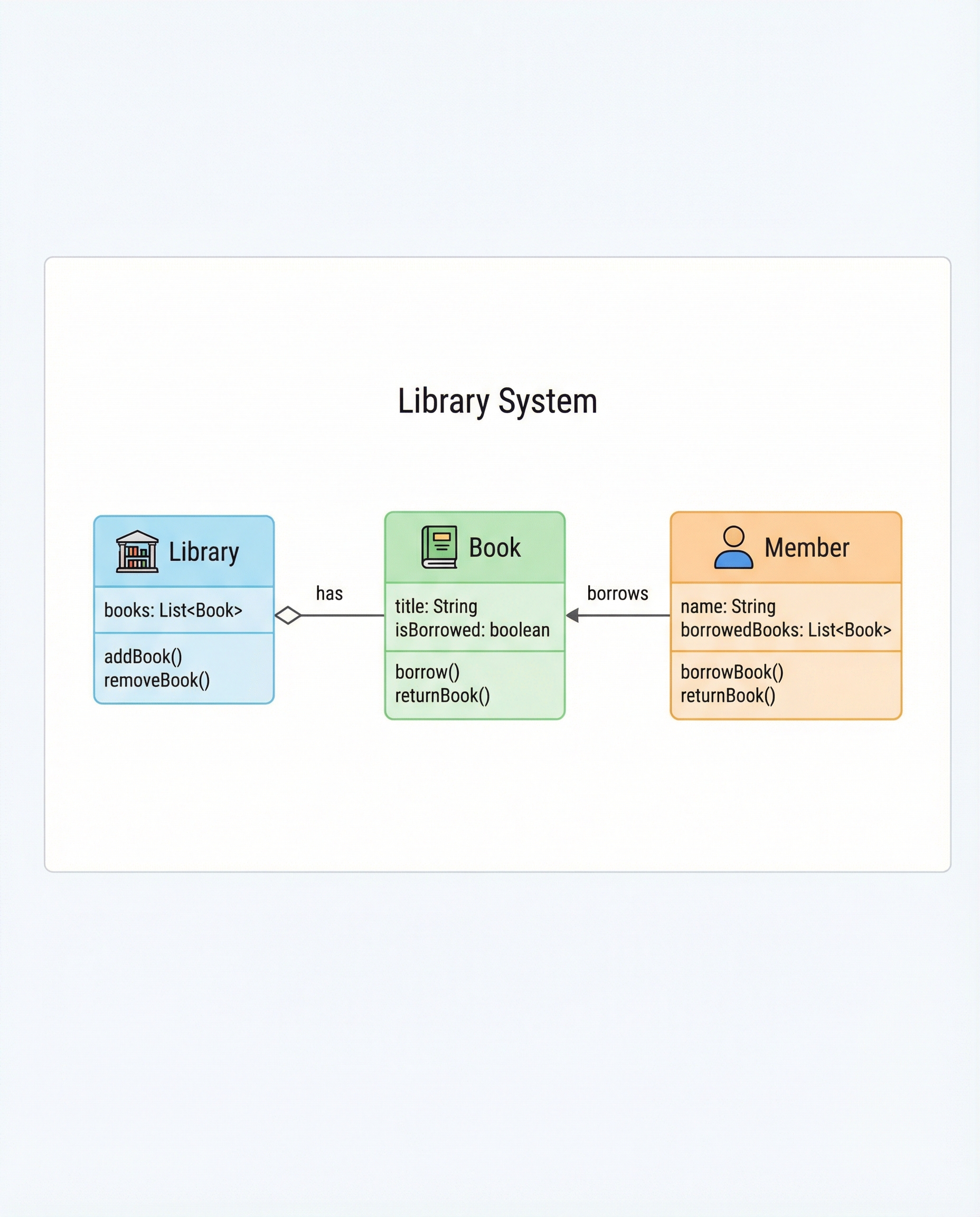
## Example: Library System (quick walkthrough)
1. Clarify: core features — add/remove books, borrow/return, search, membership.
2. Entities: Library, Book, Catalog, Member, Loan (or BorrowRecord).
3. Relationships:
- Library has Catalog and Members.
- Catalog contains Books (or BookCopies).
- Member can have multiple Loans; Loan references BookCopy and Member.
Simple class sketch (informal UML):
```
Library
- catalog: Catalog
- members: Map
+ addBook(book)
+ registerMember(member)
Catalog
- books: Map>
+ search(query): List
BookCopy
- id: String
- isbn: String
- status: AVAILABLE | LOANED
Member
- id: String
- loans: List
+ borrow(bookCopy)
+ return(bookCopy)
Loan
- bookCopyId
- memberId
- loanDate
- dueDate
```
APIs to show during interview:
- Library.borrowBook(memberId, isbn)
- Library.returnBook(memberId, bookCopyId)
- Catalog.searchByTitle(title)
Trade-offs to mention:
- Track physical copies vs only metadata (consistency vs storage cost).
- Synchronous vs asynchronous notifications for overdue books.
- Concurrency control for borrow/return (optimistic lock vs synchronized access).
## How to Present Answers in an Interview
- Start with a short summary of your approach and assumptions.
- Show entities and responsibilities quickly (1–2 min sketch).
- Drill into one or two classes and show method signatures—don’t write full code.
- Explain trade-offs and alternatives.
- If time permits, mention testing strategy and edge cases.
## Practice Tips
- Whiteboard or paper: practice sketching designs under time.
- Talk out loud: interviewers listen to your reasoning, not just the final diagram.
- Do mock interviews and review common OOD problems.
- Build small projects emphasizing OOD (e.g., reservation system, chat room).
## Final Checklist for Java OOD Interviews
- Describe which OOP principles you’re using.
- Pick Java constructs deliberately (interface vs abstract class, access level).
- Use simple, named patterns and state their trade-offs.
- Sketch a clear UML and present concise APIs.
- Explain concurrency, persistence, and scaling if relevant.
Focus on design thinking. Memorized snippets won't substitute for a clear, principled approach that you can explain under pressure.
#SoftwareEngineering #Java #SystemDesign