# High-Score SAP Labs Java Interview (5–7 YOE) — Bugfree Users' Project-First Playbook
# High-Score SAP Labs Java Interview (5–7 YOE) — Bugfree Users' Project-First Playbook
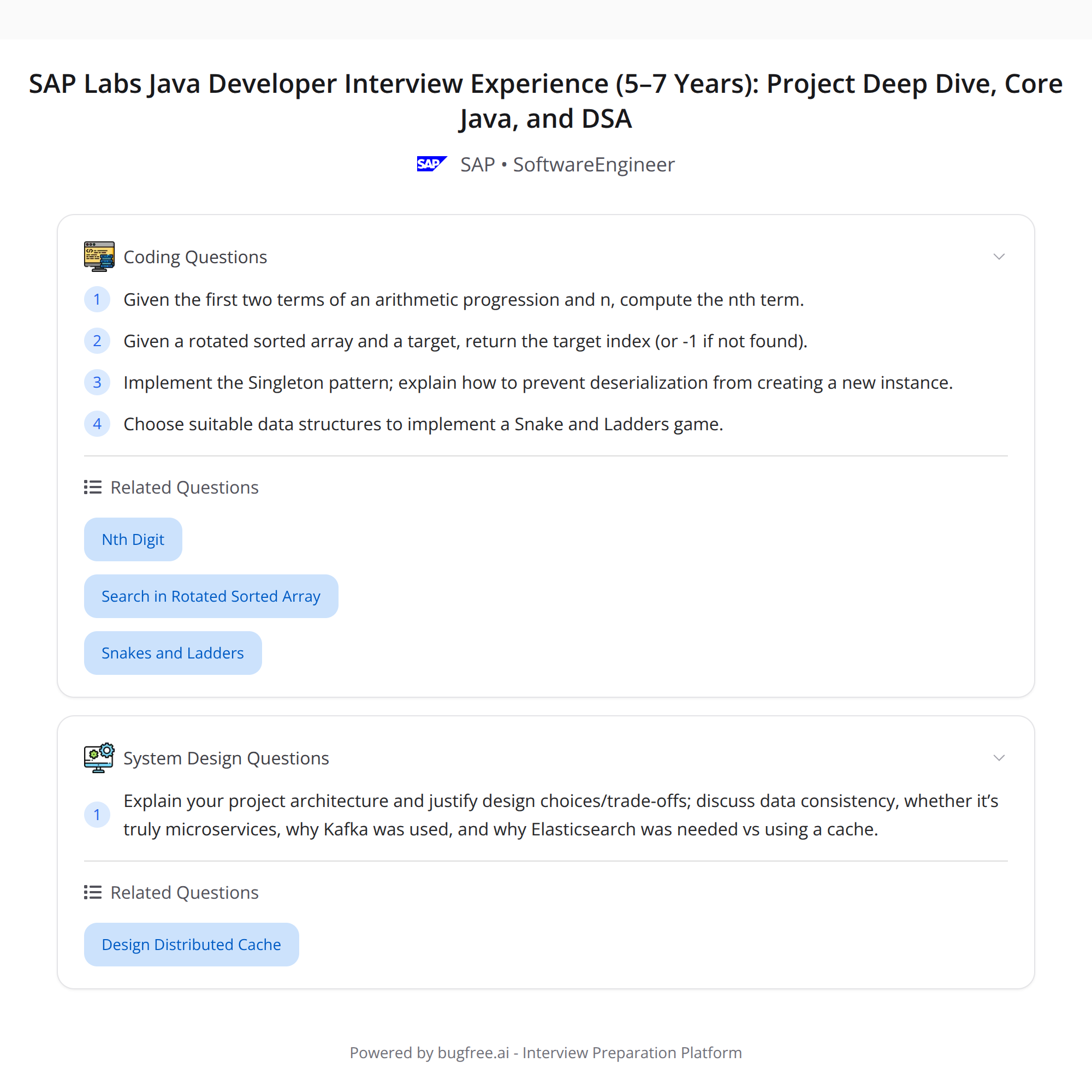 Posted by "bugfree users": a succinct, high-yield account of a successful SAP Labs Java Developer interview (5–7 years experience). The process had two focused rounds:
- Round 1: deep project dive + architecture trade-offs.
- Round 2: rapid-fire core Java, patterns and DSA.
Below is a cleaned, enriched playbook that highlights questions asked, how to prepare, and short sample responses you can adapt.
---
## Quick summary of the rounds
Round 1 (project-first)
- Heavy focus on the candidate's project: design decisions, data consistency, whether the system is "really" microservices, choice of Kafka, choice of Elasticsearch vs a simpler cache.
- Two DSA problems: nth term of an arithmetic progression (AP); search in a rotated sorted array.
Round 2 (rapid-fire)
- Ownership in stack, Strategy pattern, garbage collection, HashMap vs Hashtable internals, Singleton + deserialization safety, data structure approach for Snake & Ladders, REST responses and HTTP codes.
Key takeaway: know your project cold, and be able to switch fast between design reasoning, Java internals/patterns, and algorithmic thinking.
---
## Round 1 — Project deep-dive: what to expect and how to answer
Interviewers will probe concrete trade-offs. Be specific: mention alternatives you considered, why you rejected them, the metrics you used, and real incidents (e.g., outages or performance tuning) if any.
Common topics and how to address them:
- "Is it really microservices?"
- Explain your service boundaries, ownership, independent deployability, team ownership, data ownership and communication patterns. If you used a monolithic or a modularized monolith, say so and justify (operational complexity vs team size, latency, data consistency needs).
- "Design trade-offs & data consistency"
- Describe transactional boundaries, consistency model (strong vs eventual), how you handled distributed transactions (sagas, compensating actions) or chose to avoid them. Give concrete examples: cross-service update that required eventual consistency and how you reconciled it.
- "Why Kafka?"
- Mention use cases: decoupling producers/consumers, high throughput, durability, replayability, ordering guarantees (per-partition) and use of consumer groups for scaling. Also explain alternatives you considered (e.g., RabbitMQ, Kinesis) and why Kafka fit better.
- "Why Elasticsearch vs simpler caching?"
- Explain that Elasticsearch is for full-text search, flexible querying, scoring, analytics and near real-time indexing. A simple cache (Redis) only gives key-value lookups and limited query capability. If you used both (ES for search + Redis for hot data), say so and why.
Tips for project questions:
- Keep a concise elevator pitch of your project architecture.
- Prepare 3–4 concrete design decisions you made and the metrics/outcomes (latency, throughput, cost, simplicity).
- Be ready to diagram synchronous vs asynchronous flows and explain failure scenarios and retries.
---
## Round 1 — The two DSA tasks
1) nth term of an arithmetic progression (AP)
- Problem: Given first term a and difference d, find the nth term.
- Approach: Use the formula: nth = a + (n - 1) * d.
- Edge cases: large n leading to overflow (use long/BigInteger as needed), negative d, n <= 0 (validate input).
2) Search in a rotated sorted array
- Problem: Given a sorted array rotated at some pivot, search a target in O(log n).
- Approach: Modified binary search. At each step, determine which half is sorted; then decide whether the target lies in the sorted half or search the other half.
- Complexity: O(log n) time, O(1) space.
- Edge cases: duplicates (makes some steps ambiguous), small arrays, full rotation.
If asked to code, articulate the invariants and termination conditions before writing code.
---
## Round 2 — Rapid-fire topics and how to answer them succinctly
- Ownership in stack
- Clarify: stack holds frames (local variables, callers). Heap holds objects; GC collects heap objects when no live references remain. Stack frames are popped when functions return.
- Strategy pattern
- Intent: define a family of algorithms, encapsulate each one, and make them interchangeable. Provide a quick example: payment processing strategies (CreditCardStrategy, UpiStrategy) injected at runtime.
- Garbage collection (GC)
- Mention generations (Young, Old), major/minor GC, pause reduction strategies (G1, CMS), and basics of reachability and finalization pitfalls. If asked specifics, name GC collectors and their trade-offs.
- HashMap vs Hashtable + internals
- HashMap: unsynchronized, allows null keys/values, uses array of Node + linked lists or tree bins (Java 8+), default load factor 0.75, fail-fast iterators.
- Hashtable: synchronized, legacy, does not allow null keys/values.
- Resizing and rehash costs: discuss thresholds and complexity implications.
- Singleton + deserialization safety
- Problem: deserialization can create a new instance. Fix: implement readResolve() to return the singleton instance, or use enum singletons which are inherently safe.
- Data structure for Snake & Ladders
- Model board as graph nodes 1..N. From each node, edges correspond to dice outcomes (1..6) unless there's a snake/ladder redirect. Use BFS to find minimum dice throws to reach the final cell.
- REST responses + HTTP codes
- Common mappings: 200 OK (success), 201 Created (resource created), 204 No Content (success w/o body), 400 Bad Request (client error), 401 Unauthorized, 403 Forbidden, 404 Not Found, 409 Conflict (versioning/dup), 500 Internal Server Error.
- Also mention use of proper response bodies and consistent error schema (code, message, timestamp, requestId).
---
## Quick sample answers / phrasing
- "Why Kafka instead of direct HTTP?"
- "We needed durable, replayable streams with high throughput, and to decouple producers from consumers so downstream services could process at their own pace. Kafka's partitioning also gave us ordering where required."
- "Why Elasticsearch instead of Redis?"
- "We needed complex text search, scoring and aggregations; Redis is great for hot lookups but doesn't support full-text queries or analytics. We used Redis for hot key-value caching alongside ES for search."
- "How do you ensure data consistency across services?"
- "We scoped transactions to single services, used eventual consistency across services, and implemented sagas with compensating steps for cross-service flows. For critical operations, we used idempotency keys and verification steps."
---
## Prep checklist (what to study before an interview)
- Know your project end-to-end: diagrams, data flows, failure modes.
- Core Java internals: memory model, GC, HashMap internals, synchronization primitives.
- Design patterns: Strategy, Singleton (and pitfalls), Factory, Observer.
- Distributed systems basics: messaging (Kafka), consistency models, transactional patterns (saga), how to reason about microservices boundaries.
- Algorithms & DS: binary search variants (rotated array), BFS on implicit graphs (boards), typical array/string/linked-list problems.
- HTTP/REST semantics and common status codes.
---
## Final takeaway
Be surgical: defend your project choices with metrics and trade-offs, and switch smoothly to code-level details when asked. Interviewers expect you to know both the big picture and the Java internals that make your design work.
Good luck — and rehearse succinct stories for 4–6 design decisions from your project so you can answer confidently under pressure.
#Java #Microservices #InterviewPrep
Posted by "bugfree users": a succinct, high-yield account of a successful SAP Labs Java Developer interview (5–7 years experience). The process had two focused rounds:
- Round 1: deep project dive + architecture trade-offs.
- Round 2: rapid-fire core Java, patterns and DSA.
Below is a cleaned, enriched playbook that highlights questions asked, how to prepare, and short sample responses you can adapt.
---
## Quick summary of the rounds
Round 1 (project-first)
- Heavy focus on the candidate's project: design decisions, data consistency, whether the system is "really" microservices, choice of Kafka, choice of Elasticsearch vs a simpler cache.
- Two DSA problems: nth term of an arithmetic progression (AP); search in a rotated sorted array.
Round 2 (rapid-fire)
- Ownership in stack, Strategy pattern, garbage collection, HashMap vs Hashtable internals, Singleton + deserialization safety, data structure approach for Snake & Ladders, REST responses and HTTP codes.
Key takeaway: know your project cold, and be able to switch fast between design reasoning, Java internals/patterns, and algorithmic thinking.
---
## Round 1 — Project deep-dive: what to expect and how to answer
Interviewers will probe concrete trade-offs. Be specific: mention alternatives you considered, why you rejected them, the metrics you used, and real incidents (e.g., outages or performance tuning) if any.
Common topics and how to address them:
- "Is it really microservices?"
- Explain your service boundaries, ownership, independent deployability, team ownership, data ownership and communication patterns. If you used a monolithic or a modularized monolith, say so and justify (operational complexity vs team size, latency, data consistency needs).
- "Design trade-offs & data consistency"
- Describe transactional boundaries, consistency model (strong vs eventual), how you handled distributed transactions (sagas, compensating actions) or chose to avoid them. Give concrete examples: cross-service update that required eventual consistency and how you reconciled it.
- "Why Kafka?"
- Mention use cases: decoupling producers/consumers, high throughput, durability, replayability, ordering guarantees (per-partition) and use of consumer groups for scaling. Also explain alternatives you considered (e.g., RabbitMQ, Kinesis) and why Kafka fit better.
- "Why Elasticsearch vs simpler caching?"
- Explain that Elasticsearch is for full-text search, flexible querying, scoring, analytics and near real-time indexing. A simple cache (Redis) only gives key-value lookups and limited query capability. If you used both (ES for search + Redis for hot data), say so and why.
Tips for project questions:
- Keep a concise elevator pitch of your project architecture.
- Prepare 3–4 concrete design decisions you made and the metrics/outcomes (latency, throughput, cost, simplicity).
- Be ready to diagram synchronous vs asynchronous flows and explain failure scenarios and retries.
---
## Round 1 — The two DSA tasks
1) nth term of an arithmetic progression (AP)
- Problem: Given first term a and difference d, find the nth term.
- Approach: Use the formula: nth = a + (n - 1) * d.
- Edge cases: large n leading to overflow (use long/BigInteger as needed), negative d, n <= 0 (validate input).
2) Search in a rotated sorted array
- Problem: Given a sorted array rotated at some pivot, search a target in O(log n).
- Approach: Modified binary search. At each step, determine which half is sorted; then decide whether the target lies in the sorted half or search the other half.
- Complexity: O(log n) time, O(1) space.
- Edge cases: duplicates (makes some steps ambiguous), small arrays, full rotation.
If asked to code, articulate the invariants and termination conditions before writing code.
---
## Round 2 — Rapid-fire topics and how to answer them succinctly
- Ownership in stack
- Clarify: stack holds frames (local variables, callers). Heap holds objects; GC collects heap objects when no live references remain. Stack frames are popped when functions return.
- Strategy pattern
- Intent: define a family of algorithms, encapsulate each one, and make them interchangeable. Provide a quick example: payment processing strategies (CreditCardStrategy, UpiStrategy) injected at runtime.
- Garbage collection (GC)
- Mention generations (Young, Old), major/minor GC, pause reduction strategies (G1, CMS), and basics of reachability and finalization pitfalls. If asked specifics, name GC collectors and their trade-offs.
- HashMap vs Hashtable + internals
- HashMap: unsynchronized, allows null keys/values, uses array of Node + linked lists or tree bins (Java 8+), default load factor 0.75, fail-fast iterators.
- Hashtable: synchronized, legacy, does not allow null keys/values.
- Resizing and rehash costs: discuss thresholds and complexity implications.
- Singleton + deserialization safety
- Problem: deserialization can create a new instance. Fix: implement readResolve() to return the singleton instance, or use enum singletons which are inherently safe.
- Data structure for Snake & Ladders
- Model board as graph nodes 1..N. From each node, edges correspond to dice outcomes (1..6) unless there's a snake/ladder redirect. Use BFS to find minimum dice throws to reach the final cell.
- REST responses + HTTP codes
- Common mappings: 200 OK (success), 201 Created (resource created), 204 No Content (success w/o body), 400 Bad Request (client error), 401 Unauthorized, 403 Forbidden, 404 Not Found, 409 Conflict (versioning/dup), 500 Internal Server Error.
- Also mention use of proper response bodies and consistent error schema (code, message, timestamp, requestId).
---
## Quick sample answers / phrasing
- "Why Kafka instead of direct HTTP?"
- "We needed durable, replayable streams with high throughput, and to decouple producers from consumers so downstream services could process at their own pace. Kafka's partitioning also gave us ordering where required."
- "Why Elasticsearch instead of Redis?"
- "We needed complex text search, scoring and aggregations; Redis is great for hot lookups but doesn't support full-text queries or analytics. We used Redis for hot key-value caching alongside ES for search."
- "How do you ensure data consistency across services?"
- "We scoped transactions to single services, used eventual consistency across services, and implemented sagas with compensating steps for cross-service flows. For critical operations, we used idempotency keys and verification steps."
---
## Prep checklist (what to study before an interview)
- Know your project end-to-end: diagrams, data flows, failure modes.
- Core Java internals: memory model, GC, HashMap internals, synchronization primitives.
- Design patterns: Strategy, Singleton (and pitfalls), Factory, Observer.
- Distributed systems basics: messaging (Kafka), consistency models, transactional patterns (saga), how to reason about microservices boundaries.
- Algorithms & DS: binary search variants (rotated array), BFS on implicit graphs (boards), typical array/string/linked-list problems.
- HTTP/REST semantics and common status codes.
---
## Final takeaway
Be surgical: defend your project choices with metrics and trade-offs, and switch smoothly to code-level details when asked. Interviewers expect you to know both the big picture and the Java internals that make your design work.
Good luck — and rehearse succinct stories for 4–6 design decisions from your project so you can answer confidently under pressure.
#Java #Microservices #InterviewPrep